
Your CRM should work for you, not the other way around
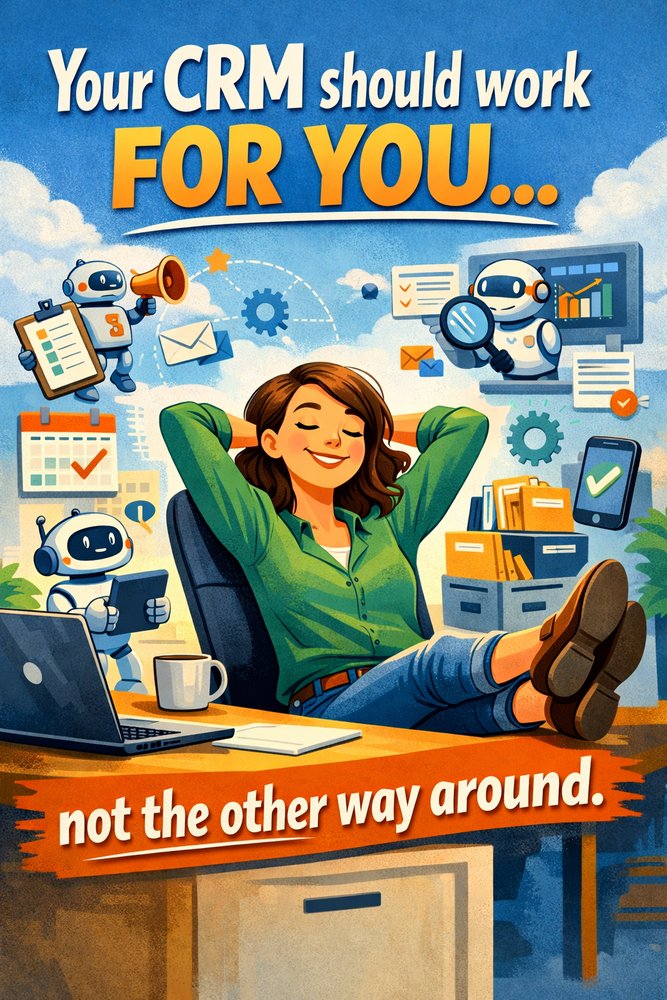
Ask anyone who quietly abandoned their CRM why they stopped, and you'll hear the same thing: keeping it up to date became another job. Every call had to be logged. Every note typed in. Every follow-up set by hand. The tool that promised to organize your customers ended up asking more of your time than the customers did.
That's the quiet failure of most CRMs. They're brilliant at storing information and useless at doing anything with it. They wait for you to remember, type, and act — and on your busiest week, exactly when you're serving the most people, the updating falls apart.
The real reason CRMs get abandoned
It's rarely the features. It's the upkeep. A CRM that only reflects reality on the days you're disciplined enough to feed it slowly drifts out of date — and once you can't trust what it says, you stop opening it. A CRM you don't trust is worse than no CRM at all, because it gives you false confidence that nothing is falling through the cracks.
A CRM shouldn't be where information goes to sit. It should be the thing that acts on it.
From a passive database to an active teammate
An AI-powered CRM flips the relationship. Instead of a filing cabinet you maintain, it behaves like a teammate who maintains it for you. The difference isn't more fields or fancier dashboards — it's who does the work.
It logs the conversation for you
Calls and messages are captured and summarized automatically, the moment they happen. No "I'll write that up later" — which, on a busy day, never comes. The record stays current whether you touched it today or not.
It schedules the follow-up the instant it's needed
How many sales are lost simply because someone forgot to follow up? When a quote goes out, an appointment ends, or a renewal approaches, the next step is set on its own and surfaces at exactly the right time — instead of depending on your memory.
It catches the customer about to slip away
The most expensive customer is the one who quietly drifts off without a word. An AI CRM watches for the signals — gone quiet, overdue for a visit, renewal lapsing — and flags them before they're gone, while you can still do something about it.
It drafts the message so you just send
The birthday wish, the festival greeting, the thank-you, the gentle nudge on an unpaid invoice — pre-written and ready, in your voice. The small gestures that make a customer feel remembered stop being the things you never get around to.
The same idea, across very different businesses
A CRM that acts on its own isn't a feature for big companies. It's most valuable when you're small and your time is the scarcest thing you have:
- A neighborhood clinic sends its own appointment and recall reminders, so the schedule fills without the front desk chasing anyone.
- A real estate agent gets a ready-to-send check-in six months after a viewing — the follow-up that usually never happens.
- An online store thanks every customer after a purchase and recommends the right next product, turning one sale into a reason to return.
- A solo consultant has every meeting and proposal captured automatically, so nothing important lives only in their head.
What a CRM you have to babysit really costs
The damage from a CRM nobody keeps current rarely shows up as one big loss. It's a steady leak — and it compounds:
- Follow-ups forgotten after the first call.
- Quotes that never got a second nudge.
- Renewals that lapsed unnoticed.
- Customers who drifted off without anyone reaching out.
- The same lead worked twice by two people.
- Service that felt impersonal because no one had the history on hand.
None of these feel like a crisis on any given day. That's exactly why they're so costly over a year.
The fix isn't more discipline
You don't close those gaps by trying harder to keep a database tidy. You close them by taking the upkeep off your plate entirely. That's the whole idea behind Vandiya's CRM — every lead and interaction lands in one place automatically, in a system you own. And once the data is flowing, your AI employees act on it: logging the calls, sending the follow-ups, requesting the reviews, and flagging the customers worth your attention.
It pairs naturally with the asset underneath it all — the customer data you own — which only grows more valuable the longer your CRM keeps it for you.